Healthcare Commercialization Is Too Important to Stay Offline
Josh Walsh
·
Healthcare Commercialization Is Too Important to Stay Offline
Josh Walsh
·
Healthcare Commercialization Is Too Important to Stay Offline
Josh Walsh
·
Over the past 15 years, I have spent much of my time with healthcare commercialization teams that are sophisticated in almost every way. They understand the patients, providers, and caregivers they serve, have extraordinary data assets, and work with deeply capable agency and publisher partners. They are also under real pressure to make their processes faster, more accountable, and more connected.
Yet when you examine how audience strategy, activation, measurement, and optimization flow through the system, much of the process still looks like the ad-networks of 20 years ago: Media executives and data resellers coordinating audience planning and buying through phone calls and emails, exchanging audience definitions in spreadsheets and PDFs.
That should bother us.
Not because healthcare marketers need nicer software (they do), but because commercialization shapes how patients, providers, and caregivers encounter information, understand treatment options, and connect to care. When the infrastructure underneath that work is slow, fragmented, and opaque, the cost is not limited to media waste. It shows up in delayed learning, missed opportunities to improve health conditions, and less confidence in the most important decisions people may ever make.
Healthcare has some of the most powerful and robust data in the world. The challenge is that the infrastructure for turning that data into responsible action has not kept up with the importance of the decisions it supports.
That is why we started BranchLab.
For too long, healthcare commercialization has relied on compromises most industries left behind more than a decade ago. Teams generate insights in one system, turn them into audiences in another, activate through separate platforms, wait months for measurement, and then try to optimize after the most valuable window to learn has already closed, all through an offline process.
Every handoff adds delay, every translation step reduces fidelity, and every disconnected workflow creates another place where context can be lost. The result is a commercialization model that is harder to understand, harder to improve, and slower than it needs to be.
That is a bad system for marketers, who are expected to make faster, more data-informed decisions; for providers, who operate inside an already noisy healthcare environment; and for patients and caregivers, who need timely, relevant information but are often reached through infrastructure that was not built around clarity, trust, or usefulness.
Healthcare cannot simply copy consumer advertising, and it should not. The data is more sensitive, the regulations are more stringent, and the ethical obligations are far higher. But respecting those constraints should not mean accepting a commercialization system that is slow by design.
It’s slow by design because the legacy market has benefited from keeping it that way. Traditional audience companies still operate like those ad networks of 20 years ago: They acquire data, package it into static segments, move files through disconnected systems, and ask customers to wait for a proxy metric to prove value later.
It’s time we leave that world behind, for good.
Our view is that the next generation of healthcare commercialization will not be built by pushing more files through the same fragmented process. It will be built by creating infrastructure that helps teams move from insight to execution in a more continuous way, makes AI useful inside regulated environments, and protects privacy without sacrificing speed, relevance, or accountability.
BranchLab does not re-sell data. We help teams explore it. We do not re-package audiences. We help teams build their own. And we do not arbitrage media. We help teams make better decisions across research, design, deployment, measurement, and optimization through a more unified, self-serve system.
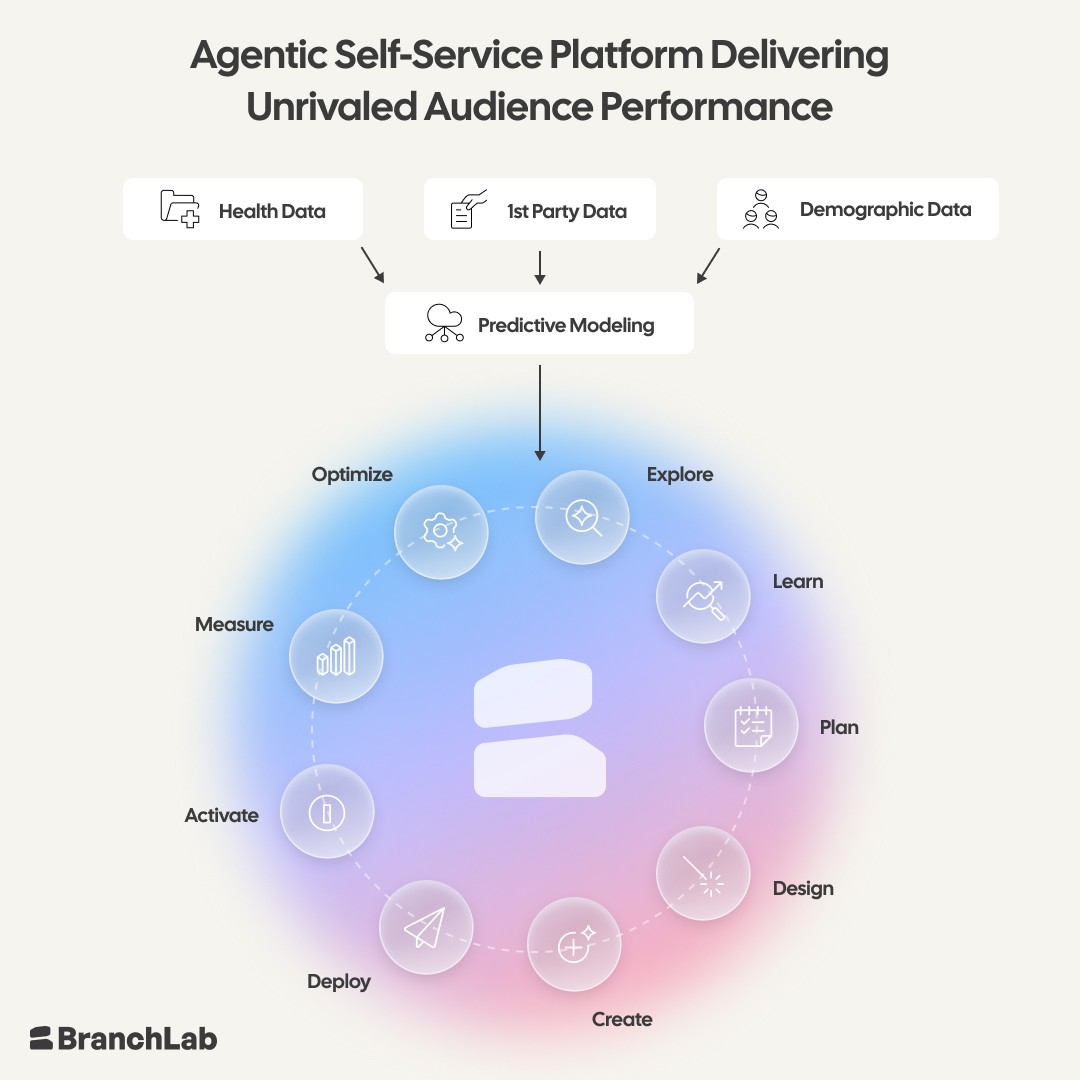
That distinction between audience-ad-network vs. platform is critical as AI becomes part of every healthcare technology conversation.
AI can be extremely useful in this market because healthcare journeys are complex, signals are distributed, and manual workflows cannot keep up with the need to learn and adapt. But in healthcare, AI has to be more than impressive in a demo. It has to be usable, governed, explainable, and trusted by commercial, legal, privacy, data science, agency, and media teams at the same time.
That is the standard we are building toward.
Our recent Series A gives us more room to build against that standard. But capital does not fix the system. The financing only matters if we use it to build the next layer correctly.
That is also why this investor group matters to us. McKesson Ventures brings deep perspective on access, affordability, distribution, provider workflows, and manufacturer needs. Sanofi Ventures understands global pharma, where innovation has to be matched by responsibility and AI has to operate inside regulated environments. FCA Venture Partners brings experience scaling healthcare technology companies, and AIX Ventures brings applied AI expertise at a moment when the market needs systems that can survive contact with real regulated workflows, not just controlled demos.
Each of those perspectives is valuable because the problem we are solving does not sit neatly inside one function. It touches data, privacy, commercial strategy, media, measurement, product, AI, and healthcare operations. Solving it requires more than a better audience; it requires a better operating model for how healthcare commercialization learns and acts.
The market has given BranchLab a chance to help build that model, but a chance is not the same thing as a win. We will earn it by building products people trust, simplifying workflows that have been overcomplicated, and proving that a more modern commercialization system can also be a more responsible one.
A healthier healthcare ecosystem will not come from commercialization alone, and we should be careful not to pretend otherwise. But commercialization does shape how information moves, how people learn about options, and how healthcare organizations connect patients, providers, and caregivers to therapies and resources that can improve lives.
The Series A is a milestone we are proud of, but it is mostly a reminder that the work ahead is larger than the company we have built so far. The next chapter is not about proving that healthcare commercialization can use more technology. It is about proving that the right technology can help organizations operate more efficiently and responsibly, improve efficacy, and build trust in a fragmented privacy landscape that will only continue to evolve.
That is the system BranchLab is building toward: Faster without being thoughtless, more intelligent without being black-box, and more effective without losing sight of the patients, providers, and caregivers we and this industry ultimately exists to serve.
Over the past 15 years, I have spent much of my time with healthcare commercialization teams that are sophisticated in almost every way. They understand the patients, providers, and caregivers they serve, have extraordinary data assets, and work with deeply capable agency and publisher partners. They are also under real pressure to make their processes faster, more accountable, and more connected.
Yet when you examine how audience strategy, activation, measurement, and optimization flow through the system, much of the process still looks like the ad-networks of 20 years ago: Media executives and data resellers coordinating audience planning and buying through phone calls and emails, exchanging audience definitions in spreadsheets and PDFs.
That should bother us.
Not because healthcare marketers need nicer software (they do), but because commercialization shapes how patients, providers, and caregivers encounter information, understand treatment options, and connect to care. When the infrastructure underneath that work is slow, fragmented, and opaque, the cost is not limited to media waste. It shows up in delayed learning, missed opportunities to improve health conditions, and less confidence in the most important decisions people may ever make.
Healthcare has some of the most powerful and robust data in the world. The challenge is that the infrastructure for turning that data into responsible action has not kept up with the importance of the decisions it supports.
That is why we started BranchLab.
For too long, healthcare commercialization has relied on compromises most industries left behind more than a decade ago. Teams generate insights in one system, turn them into audiences in another, activate through separate platforms, wait months for measurement, and then try to optimize after the most valuable window to learn has already closed, all through an offline process.
Every handoff adds delay, every translation step reduces fidelity, and every disconnected workflow creates another place where context can be lost. The result is a commercialization model that is harder to understand, harder to improve, and slower than it needs to be.
That is a bad system for marketers, who are expected to make faster, more data-informed decisions; for providers, who operate inside an already noisy healthcare environment; and for patients and caregivers, who need timely, relevant information but are often reached through infrastructure that was not built around clarity, trust, or usefulness.
Healthcare cannot simply copy consumer advertising, and it should not. The data is more sensitive, the regulations are more stringent, and the ethical obligations are far higher. But respecting those constraints should not mean accepting a commercialization system that is slow by design.
It’s slow by design because the legacy market has benefited from keeping it that way. Traditional audience companies still operate like those ad networks of 20 years ago: They acquire data, package it into static segments, move files through disconnected systems, and ask customers to wait for a proxy metric to prove value later.
It’s time we leave that world behind, for good.
Our view is that the next generation of healthcare commercialization will not be built by pushing more files through the same fragmented process. It will be built by creating infrastructure that helps teams move from insight to execution in a more continuous way, makes AI useful inside regulated environments, and protects privacy without sacrificing speed, relevance, or accountability.
BranchLab does not re-sell data. We help teams explore it. We do not re-package audiences. We help teams build their own. And we do not arbitrage media. We help teams make better decisions across research, design, deployment, measurement, and optimization through a more unified, self-serve system.
That distinction between audience-ad-network vs. platform is critical as AI becomes part of every healthcare technology conversation.
AI can be extremely useful in this market because healthcare journeys are complex, signals are distributed, and manual workflows cannot keep up with the need to learn and adapt. But in healthcare, AI has to be more than impressive in a demo. It has to be usable, governed, explainable, and trusted by commercial, legal, privacy, data science, agency, and media teams at the same time.
That is the standard we are building toward.
Our recent Series A gives us more room to build against that standard. But capital does not fix the system. The financing only matters if we use it to build the next layer correctly.
That is also why this investor group matters to us. McKesson Ventures brings deep perspective on access, affordability, distribution, provider workflows, and manufacturer needs. Sanofi Ventures understands global pharma, where innovation has to be matched by responsibility and AI has to operate inside regulated environments. FCA Venture Partners brings experience scaling healthcare technology companies, and AIX Ventures brings applied AI expertise at a moment when the market needs systems that can survive contact with real regulated workflows, not just controlled demos.
Each of those perspectives is valuable because the problem we are solving does not sit neatly inside one function. It touches data, privacy, commercial strategy, media, measurement, product, AI, and healthcare operations. Solving it requires more than a better audience; it requires a better operating model for how healthcare commercialization learns and acts.
The market has given BranchLab a chance to help build that model, but a chance is not the same thing as a win. We will earn it by building products people trust, simplifying workflows that have been overcomplicated, and proving that a more modern commercialization system can also be a more responsible one.
A healthier healthcare ecosystem will not come from commercialization alone, and we should be careful not to pretend otherwise. But commercialization does shape how information moves, how people learn about options, and how healthcare organizations connect patients, providers, and caregivers to therapies and resources that can improve lives.
The Series A is a milestone we are proud of, but it is mostly a reminder that the work ahead is larger than the company we have built so far. The next chapter is not about proving that healthcare commercialization can use more technology. It is about proving that the right technology can help organizations operate more efficiently and responsibly, improve efficacy, and build trust in a fragmented privacy landscape that will only continue to evolve.
That is the system BranchLab is building toward: Faster without being thoughtless, more intelligent without being black-box, and more effective without losing sight of the patients, providers, and caregivers we and this industry ultimately exists to serve.
Over the past 15 years, I have spent much of my time with healthcare commercialization teams that are sophisticated in almost every way. They understand the patients, providers, and caregivers they serve, have extraordinary data assets, and work with deeply capable agency and publisher partners. They are also under real pressure to make their processes faster, more accountable, and more connected.
Yet when you examine how audience strategy, activation, measurement, and optimization flow through the system, much of the process still looks like the ad-networks of 20 years ago: Media executives and data resellers coordinating audience planning and buying through phone calls and emails, exchanging audience definitions in spreadsheets and PDFs.
That should bother us.
Not because healthcare marketers need nicer software (they do), but because commercialization shapes how patients, providers, and caregivers encounter information, understand treatment options, and connect to care. When the infrastructure underneath that work is slow, fragmented, and opaque, the cost is not limited to media waste. It shows up in delayed learning, missed opportunities to improve health conditions, and less confidence in the most important decisions people may ever make.
Healthcare has some of the most powerful and robust data in the world. The challenge is that the infrastructure for turning that data into responsible action has not kept up with the importance of the decisions it supports.
That is why we started BranchLab.
For too long, healthcare commercialization has relied on compromises most industries left behind more than a decade ago. Teams generate insights in one system, turn them into audiences in another, activate through separate platforms, wait months for measurement, and then try to optimize after the most valuable window to learn has already closed, all through an offline process.
Every handoff adds delay, every translation step reduces fidelity, and every disconnected workflow creates another place where context can be lost. The result is a commercialization model that is harder to understand, harder to improve, and slower than it needs to be.
That is a bad system for marketers, who are expected to make faster, more data-informed decisions; for providers, who operate inside an already noisy healthcare environment; and for patients and caregivers, who need timely, relevant information but are often reached through infrastructure that was not built around clarity, trust, or usefulness.
Healthcare cannot simply copy consumer advertising, and it should not. The data is more sensitive, the regulations are more stringent, and the ethical obligations are far higher. But respecting those constraints should not mean accepting a commercialization system that is slow by design.
It’s slow by design because the legacy market has benefited from keeping it that way. Traditional audience companies still operate like those ad networks of 20 years ago: They acquire data, package it into static segments, move files through disconnected systems, and ask customers to wait for a proxy metric to prove value later.
It’s time we leave that world behind, for good.
Our view is that the next generation of healthcare commercialization will not be built by pushing more files through the same fragmented process. It will be built by creating infrastructure that helps teams move from insight to execution in a more continuous way, makes AI useful inside regulated environments, and protects privacy without sacrificing speed, relevance, or accountability.
BranchLab does not re-sell data. We help teams explore it. We do not re-package audiences. We help teams build their own. And we do not arbitrage media. We help teams make better decisions across research, design, deployment, measurement, and optimization through a more unified, self-serve system.
That distinction between audience-ad-network vs. platform is critical as AI becomes part of every healthcare technology conversation.
AI can be extremely useful in this market because healthcare journeys are complex, signals are distributed, and manual workflows cannot keep up with the need to learn and adapt. But in healthcare, AI has to be more than impressive in a demo. It has to be usable, governed, explainable, and trusted by commercial, legal, privacy, data science, agency, and media teams at the same time.
That is the standard we are building toward.
Our recent Series A gives us more room to build against that standard. But capital does not fix the system. The financing only matters if we use it to build the next layer correctly.
That is also why this investor group matters to us. McKesson Ventures brings deep perspective on access, affordability, distribution, provider workflows, and manufacturer needs. Sanofi Ventures understands global pharma, where innovation has to be matched by responsibility and AI has to operate inside regulated environments. FCA Venture Partners brings experience scaling healthcare technology companies, and AIX Ventures brings applied AI expertise at a moment when the market needs systems that can survive contact with real regulated workflows, not just controlled demos.
Each of those perspectives is valuable because the problem we are solving does not sit neatly inside one function. It touches data, privacy, commercial strategy, media, measurement, product, AI, and healthcare operations. Solving it requires more than a better audience; it requires a better operating model for how healthcare commercialization learns and acts.
The market has given BranchLab a chance to help build that model, but a chance is not the same thing as a win. We will earn it by building products people trust, simplifying workflows that have been overcomplicated, and proving that a more modern commercialization system can also be a more responsible one.
A healthier healthcare ecosystem will not come from commercialization alone, and we should be careful not to pretend otherwise. But commercialization does shape how information moves, how people learn about options, and how healthcare organizations connect patients, providers, and caregivers to therapies and resources that can improve lives.
The Series A is a milestone we are proud of, but it is mostly a reminder that the work ahead is larger than the company we have built so far. The next chapter is not about proving that healthcare commercialization can use more technology. It is about proving that the right technology can help organizations operate more efficiently and responsibly, improve efficacy, and build trust in a fragmented privacy landscape that will only continue to evolve.
That is the system BranchLab is building toward: Faster without being thoughtless, more intelligent without being black-box, and more effective without losing sight of the patients, providers, and caregivers we and this industry ultimately exists to serve.